Melodic Line Construction: “Oppositionality”

When we hear the word “line” in the context of “bass line” or “melody line” we tend to think in terms of scales and/or chord tones as we are learning theory. This is good.
There is a further level of thought about lines that has to do with the notes not in the scales or chords; the use of non-chord, non-scale tones has been more accepted since the late forties and the advent of be-bop; boppers began to discover the oppositional power of the notes around the chord tones. The melodic thinking that started to emerge through the horn of Charlie Parker (who heard the beginnings of this thinking in Lester Young’s work) continued to evolve in subsequent generations of players. There is a famous Miles Davis quote: “Play what isn’t there.”
Miles was famous for his “wrong“ notes that sound so incredibly expressive and individual; he was the master of the non-harmonic tone. As a bandleader, he had the luxury of experiencing the sound of every possible non-harmonic tone without getting fired – it was HIS band… and consequently ended up with a 12-tone (and everything in between) sonic palette, knowing how every “wrong” note would sound against every chord.
Music is dynamic; we’ve heard of “tension and release?” There is tension and release within the universe of melody itself as harmonies are expressed, either by playing them, or opposing them and resolving to them. This suggests a characteristic that a note might possess; any note could be harmonic, or oppositional – or incidental to those 2 functions.
If you have the means to play a chord in a loop, set it up; or maybe keep keys depressed by wedging matchbooks in your keyboard. We’re going to see how every chromatic tone sounds against a C major chord, and how we can create context for it—so it sounds great.
It’s good to try this at home first! It can be hazardous to your job to show up with your oppositional tones blazing! Use your taste and discretion… But, if you’ve been feeling “in a rut” with your playing, this is a great way out of the rut.
Lets start with a G# against a C triad:
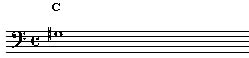
Just letting the note ring has an interesting and exotic sonority – it creates a set of harmonic implications (which are worth exploring in themselves) but for our purposes, let’s resolve it..
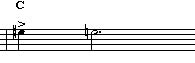
Satisfying, no? This melodic device is heard often in Miles’ work.
Let’s look at a C#. Very oppositional!—although, maybe not so oppositional if the chord is a C7b9, or if we’re in F minor…
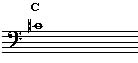
Yet very satisfying when resolved.
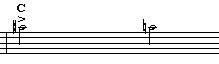
A note like this creates more tension, and greater release. If oppositionality is what we’re after, how could this note be “wrong?”
Try the other non-chord, non-scale tones – and resolve them to a chord tone… try either by step, or leap, up or down. The world begins to open… Ultimately, music is more about the sounds we make, and our power to make them, and our familiarity with the result, than it is about following the “rules” for the sake of “safety.” It’s right to know what wrong sounds like… and how to incorporate it into your personal sonic palette.
More on this next week! Incidental notes…
“and consequently ended up with a 12-tone (and everything in between) sonic palette, knowing how every “wrong” note would sound against every chord” — heh, well, that made me laugh, but I think it's maybe wrong ;) More plausible is the emergence of the group of musical thinkers who would congregate at Gil Evan's apt (this was before musicians became obsessed with 'owning' their style) and from that the landmark work “The Lydian Chromatic Concept of Tonal Organization” (aka “The Concept) of which Miles was an ardent devotee. Lydian Chromatic does not accept diatonic harmony as such, but rather a weighted graph of “tonal gravities” whereby every note COULD have a legal place in any harmonic background, only the specific gravity would vary.
Oh, credit where due, I meant to add that The Concept was the work of George Russell, another master of the perfect 'wrong' note
Here is an interesting critique of George Russell's work:
http://www.jeff-brent.com/Lessons/LCC/LCCdiscre…
There are many roads to the same place. A system derived by stacking fifths away from a hypothetical “do” is an important contribution, and got a lot of guys thinking. I've been interested in the non-conformities between the overtone series and the diatonic system, myself.
In my estimation, the harmonic action is down in the meat, the first several partials of the overtone series, and the presence of other tones in alliance or contrast with those. The diatonic system is an venerable practical solution, well baked into the Western ear…
as are non-harmonic oppositions to the equal-tempered system. Oppositionality can occur in any system, provided there IS a system that's established.
My guess is that Miles spent a lot more time on the bandstand playing with an equal-tempered piano than sitting around with George Russell and his acolytes; how he arrived at the use of non-harmonic tones is of relatively less import than the value of the concept of “oppositionality,” which in and of itself as a very potent component of melodic development… no matter HOW you got to it.
-jb
Yeah, Jon. Look to the so-called “non-chord” tones. That's where American music gets its harmonic identity. Consonate the dominant 7. It's really what the Ancient Greeks did in their descending construction of tetrachordal modes. It's also inclusive of the consonance inherent in the overtone series, which was Leonard Bernstein's error in “The Unanswered Question.” But that leads to a, for the time being, philosophical question of the validity of Western Art music as real music, which leads to Joe Henderson's observation of Solution vs. Problem.
An article, ” 'Out of Notes': Signification, Interpretation, and the Problem of Miles Davis” by Rob Walser, explains how these “wrong notes” of Davis's that criticly branded him as simultaneously as a visionary and charlattan were the result of a musician who strove to play the most difficult and challenging things in the most beautiful manner. Not so much experimenting with scales on-stage. Miles was a control freak and wanted to look and sound his best. Part of this strategy included playing the most demanding music of his day. Those cracked notes aren't about not being consistent or too stoned to play easy things. He opted to play passages that seemed simple, but were really quite difficult. And his theory was highly developed. Check out his pianists. They were all on top of their theory to point of originality. Walser's article, is worth reading, particularly for the student of jazz studies. I only have problems with a few parts of the transcription and his attempt to include Gates's Signifyin(g) analysis. But I'm still working on learning this rather important part of music appreciation myself.
Later,
RBH
Yeah, Jon. Look to the so-called “non-chord” tones. That's where American music gets its harmonic identity. Consonate the dominant 7. It's really what the Ancient Greeks did in their descending construction of tetrachordal modes. It's also inclusive of the consonance inherent in the overtone series, which was Leonard Bernstein's error in “The Unanswered Question.” But that leads to a, for the time being, philosophical question of the validity of Western Art music as real music, which leads to Joe Henderson's observation of Solution vs. Problem.
An article, ” 'Out of Notes': Signification, Interpretation, and the Problem of Miles Davis” by Rob Walser, explains how these “wrong notes” of Davis's that criticly branded him as simultaneously as a visionary and charlattan were the result of a musician who strove to play the most difficult and challenging things in the most beautiful manner. Not so much experimenting with scales on-stage. Miles was a control freak and wanted to look and sound his best. Part of this strategy included playing the most demanding music of his day. Those cracked notes aren't about not being consistent or too stoned to play easy things. He opted to play passages that seemed simple, but were really quite difficult. And his theory was highly developed. Check out his pianists. They were all on top of their theory to point of originality. Walser's article, is worth reading, particularly for the student of jazz studies. I only have problems with a few parts of the transcription and his attempt to include Gates's Signifyin(g) analysis. But I'm still working on learning this rather important part of music appreciation myself.
Later,
RBH
maybe the opposing rhythm should at least move along with the lead? I don't know… :D
maybe the opposing rhythm should at least move along with the lead? I don't know… :D
thanks for the inspiration. i feel what you’re saying. the Miles Davis reference gave clarity to your article