Bass Lesson Archives - Page 17

Lesson: Minor Tetrachord Patterns
In the last tetrachord lesson we went over the concept of tetrachords and how they change the way we think about scale patterns. In that lesson the focus was the major modes and a question was posted asking about the melodic minor and harmonic minor modes. Therefore this week’s article will go over tetrachords in the melodic minor and how...

Live looping: Thinking Outside the Box
I was in a music retail outlet recently where I purchased a Boss RC-20XL Loop Station. A great piece of kit, a glowing review of which I will post separately. What occurred to me, as the eager shop assistant demo’d the device, was that live looping may have become a little typecast in the minds of many musicians; i.e. a...

Lesson: Scale Patterns from Tetrachord Combinations
We normally think of scales in terms of eight-note patterns and treat them as a unit. There are the standard modal forms for both major and minor, the bop variations, blues variations, but all of these still cling to the paradigm of an octave based scale unit (even if the total number of notes in the scale changes). As bassists...

Rhythm Practice: Using Rhythms to Improve a Passage, Phrase or Lick
Every so often there is a passage, phrase or “lick” that we just can’t seem to execute as well as we would like, no matter how many times we practice it under tempo. This should be a sign that we need to change our approach. Slow practice an excellent and valuable tool, but it is just one of many ways...
Crafting your Core Sound
As an upright player you have to make many moving parts work together in order to get the tone you want. Both hands play different roles in crafting your tone, but the real voice of our instrument comes from the bow. If you are new to the upright and haven’t taken the time to really find and fine tune your...
Optimized Techniques for Marathon Gigs
How many times have you played a continuous four hour gig? Have you ever had to go from the studio to a gig? Or play two gigs in one day? If you have, you understand the important of having an optimized playing technique. If you have not, and are going to try, you need to prepare yourself to be as...
Math and Music – Equations and Ratios
Previously in the “math and music” lesson we derived equations for expressing intervals as functions of relative frequencies. This week we’re going to define conventions for interval sizes and then derive three variables where we can determine the composition of any frequency ratio. Guess what – all intervals can be described as different combinations of the octave, perfect fifth and...
The Lowdown with Dr. D.: Upright Slap Bass: Starter tips and etudes
This is part 2 of the Upright Slap Bass series by Dr. D. Check out Part 1 and Part 3. Here are a few etudes to help you improve your slapping. We will use a two octave G blues scale (6 note version) as our starting point. You can use any scale, arpeggio or lick you want, but this is...
Efficient 20 Minute Practice
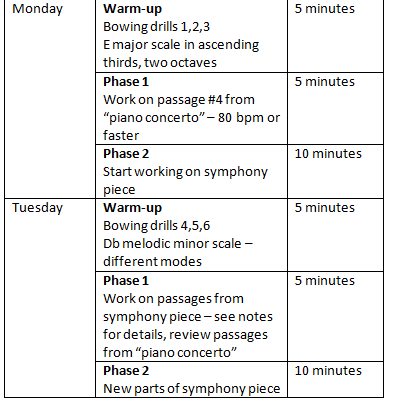
How often do you hear people claim that it’s not how much your practice but how efficiently you practice? There are always claims that practicing 15-30 minutes every day versus a 3 hour session every Saturday will have a more positive impact on your playing ability – but how do you make the most of those 15-30 minutes? In this...

Math and Music: Intervals
Every musician should have an idea of the foundational concepts that allow us to create music. This lesson series will explore the basis for tonal structure in Western music. I’ll warn you right now, this lesson is not for the faint of heart, or math-phobic. The purpose of this is to add to the conceptual foundation from which we view...
The Lowdown with Dr. D.: Upright Slap Bass (Rockabilly/Psychobilly etc.) – Intro: part 1 of 3
In my opinion, one of the more interesting things you can do on the Upright these days is Slap it! Beyond it’s hipitude, it is a legitimate technique, just like arco (bow) and pizzicato (plucked), and it can make you more employable if you master it. So let’s take a look at the technique. What is Upright Slap Bass? (in...
Double Stops on the Upright Bass
The upright bass is frequently classified as a “single-line” instrument. In other words, the bass produces a single line of tones and does not play polyphonically. This is certainly the rule in many cases, but there are times where adding additional chord tones to your playing, especially in solos, can add a new dimension of depth to your sound. Given...